
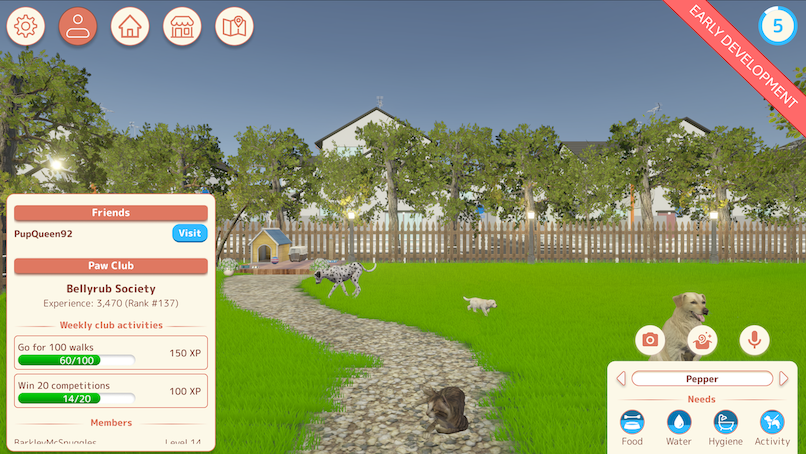
Multiplayer and cozy design do not automatically fit together. Done poorly, social systems introduce pressure that weakens companion routines. Done well, they add belonging, shared momentum, and reasons to keep playing without forcing competition every day. Paw Clubs are PawFriends' answer to that challenge. This article explains what cozy multiplayer should look like in practice and why social design details matter as much as big feature labels.
Table of Contents
The Core Tension in Cozy Multiplayer
Cozy play is about comfort, rhythm, and low pressure. Multiplayer systems often emphasize urgency and comparison. If those systems are not carefully tuned, cozy tone collapses quickly.
The design goal is not removing challenge. It is making challenge optional and keeping the care loop emotionally safe.
Why Shared Goals Work Better
Shared goals let players contribute in different ways. Some players bring consistency. Others bring focused bursts. Both can matter. This flexibility usually creates healthier communities than rank-only systems.
When every social mechanic is leaderboard-driven, casual players disengage. In cozy genres, that hurts retention and community mood.
Healthy Social Signals
- Multiple contribution paths.
- Clear team milestones.
- Optional competition layers.
- No heavy punishment for missed days.
Flexible Participation for Real Schedules
Mobile players do not have fixed availability. Good club systems respect that. If contribution only counts at high frequency, communities become exclusionary by design.
Flexible participation keeps groups welcoming and improves long-term consistency. This is one of the biggest practical advantages of cozy-first multiplayer tuning.
Friendly Competition Boundaries
Competition can be useful motivation, but framing is everything. If only top ranks get visibility, social dynamics get sharp quickly. If progress and effort are also recognized, communities stay healthier.
PawFriends benefits when club competition feels like shared momentum and celebration, not constant pressure.
Guiding Principle
In cozy multiplayer, people should feel invited to participate, not tested every session.
Solo and Social Balance
Not every player wants social interaction every day. A strong system allows smooth movement between solo routine and social events without progress penalties.
This keeps the game accessible for quieter players and reduces fatigue for players with changing weekly bandwidth.
Club Culture and Communication
Systems create structure, but culture is shaped by communication. Clear expectations, supportive language, and visible contribution context reduce conflict and improve retention.
Small UX choices can strongly influence tone. How progress is displayed often matters as much as what is rewarded.
Long-Term Value for Different Player Types
Paw Clubs can support competitive players, social players, and quiet routine players when participation paths are diverse. That diversity is what makes multiplayer sustainable in a cozy pet game.
For connected reading, see Multiplayer Pet Game and Agility, Obedience, and Disc Competitions.
Follow the PawFriends Journey
Join the newsletter for devlog updates, Kickstarter milestones, and important progress notes.
Join newsletter updatesFrequently Asked Questions
Do I need to join a Paw Club to enjoy PawFriends?
No. Core progression and care loops should remain meaningful in solo play.
Can cozy multiplayer include competition?
Yes, if competition is optional and balanced by cooperative goals and friendly framing.
What is the biggest risk in social pet systems?
Making rank pressure the only visible value signal, which usually pushes cozy players away.
How can clubs stay welcoming long term?
By supporting flexible contribution, clear expectations, and communication that rewards consistency.